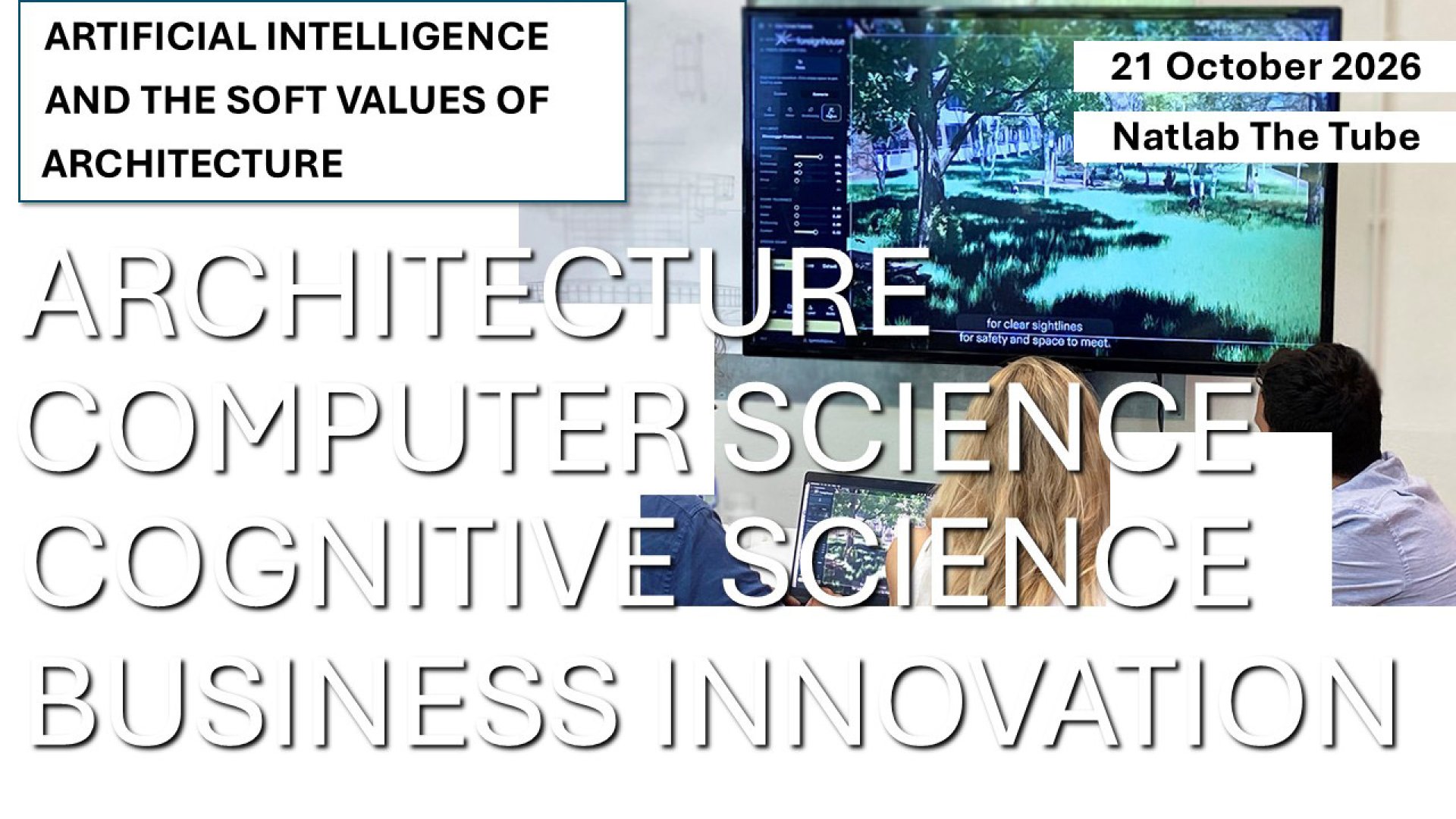
The session on Wednesday 21 October morning at Natlab brings together researchers, designers, and professionals to explore and debate how AI can open new opportunities to empower soft values in design. Soft values refer to individual and collective perception, experiences, behaviors, interactions related to emotions and cognition. The design of the built environment at all scales has large impact on people’s well-being, health, individual and collective perception, social dynamics. During the session, we debate the role of new computational techniques, such as sentiment analysis, knowledge graphs, affective computing, and human-centred predictive models, to enable the inclusion of subjective experiences and emotions in design workflows. The goal is not to replace designers, but to support designers, envisioning AI as a form of ‘co-intelligence’ that enriches the design process. The event fosters a positive impact on people’s well-being, health, social interactions in the built environment.
The Program (h. 9.00 to 12.30)
The program brings together perspectives from cognitive science, architecture, and computational design and is structured in two main parts. The first part features invited experts who present their research, insights, and concrete examples, offering complementary perspectives on the opportunities and challenges at the intersection of these fields. The second part shifts to an interactive panel discussion with the audience. Short interventions and elevator pitches introduce diverse, provocative viewpoints, opening new lines of discussion. The session fosters an open exchange between speakers and participants, promoting dialogue across disciplines.
The program runs 9.00 to 12.30 and is structured in two main parts. After a warmup activity to break the ice and bring us into the content, short presentations are given by Assoc. Prof. Michela Turrin and Ir. Antonia Sattler, welcoming and introducing the vision beyond the program and proposing thoughts on the role of AI for soft values in architecture; arch. Bart Mispelblom Beyer and arch. Lars Rutten, presenting practice-based examples and roadmaps; speakers with cognitive science and computer science background. After a short coffee break, an interactive exchange will be held, pivoting around short pitches to sparkle ideas and thought provoking positions, with panelists from several disciplines.
Meet the speakers
Assoc. Prof. Michela Turrin - Leader of the Digital Technologies Section at the TU Delft Architectural Engineering and Technology Department, Michela has been leader and proactive contributor in several (inter)national research projects and educational activities on computational design and AI in architecture. Among recent collaborations, she has been Visiting Professor at La Sapienza in Rome and AMC Fellow at TU Munich. Michela’s presentation will introduce the PLAIA project vision - and her boarder research line on (neurocognitive) computational design.
Ir. Bart Mispelblom Beyer - Architect and urban designer, Bart co-founded, with Charlotte ten Dijke, TANGRAM Architecture and Urban Landscape, known for sustainable, high-density architecture and innovative care environments. As Visiting Professor of Architecture at Roger Williams University, focusing on sustainable density, he held a similar role at the University of the District of Columbia’s CAUSES faculty. His research connects human values with AI-assisted design.
Ir. Lars Rutten - Partner at Groosman Architekten, Lars has been affiliated with Groosman since 2014, leading various projects such as utility buildings, area developments and large-scale urban housing projects, including Stadshart Lage Zijde in Alphen aan den Rijn, SPOT in Lelystad, Limesplein in Valkenhorst (Katwijk), P+R Meijersplein in Rotterdam, The Prince of Delft, Binckpark in The Hague and Mark Cascadepark in Almere. Lars’ presentation will address several applications of AI in architectural practice.
MSc. Fatih Deniz - PhD candidate at TU Eindhoven, in the department of Industrial Engineering & Innovation Science in Human Technology Interaction group, Fatih has a background in behavioral research, statistics, and machine learning. His research lies at the intersection of environmental psychology, visual perception, architecture and machine learning, with a particular focus on the indoor spaces. Fatih’s presentation will address how the physical environments we live, and work shape the way we feel, and how computational models can help us understand this relationship.