Contradiction
What if the material we rely on to protect ourselves from climate change is also contributing to it?
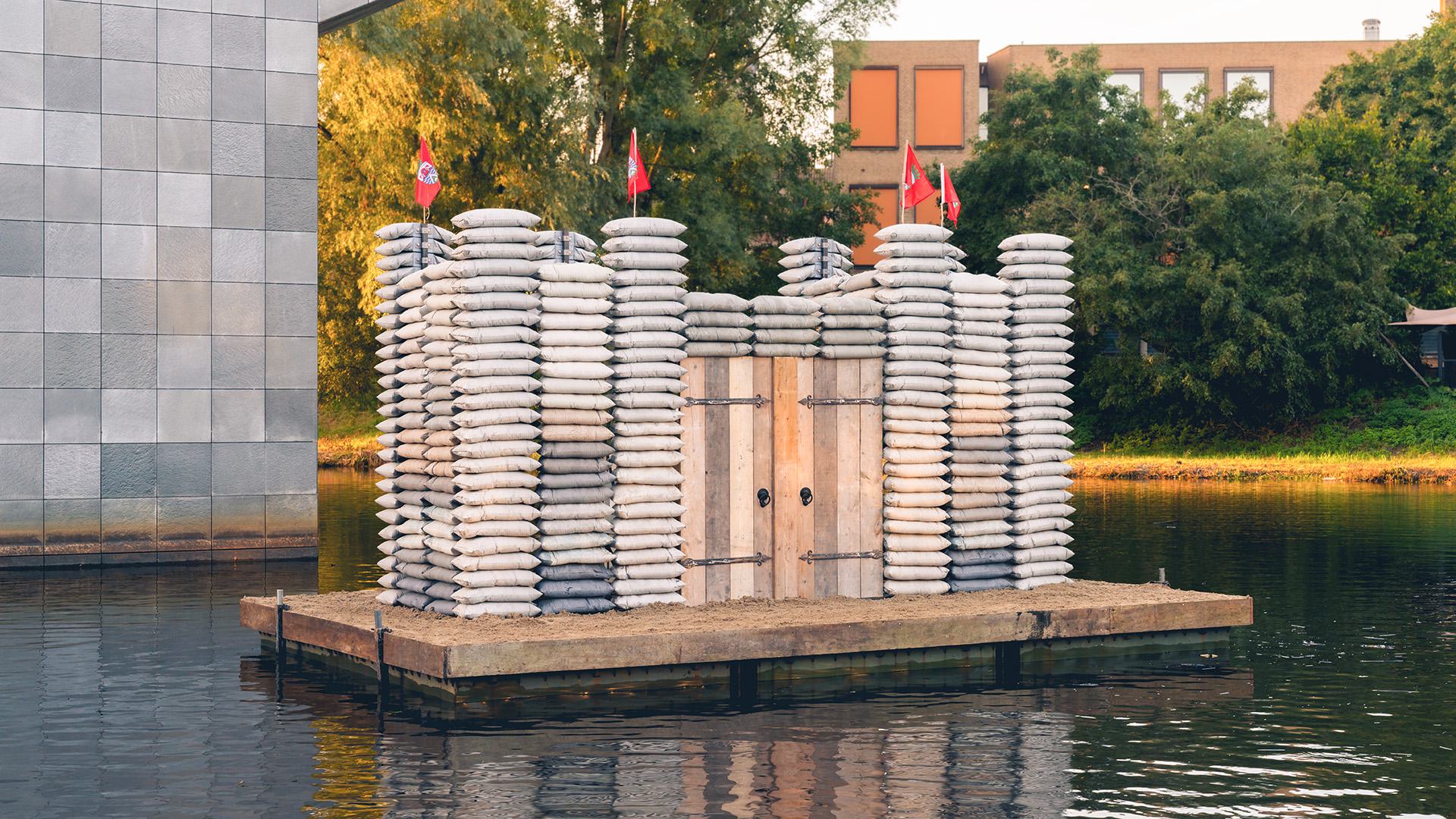
Sandbag Castle brings this contradiction into view. Hundreds of what appear to be sandbags are stacked into a castle, surrounded by water. A sandbag is one of the first lines of defence against rising water; a castle is an ancient symbol of protection. All of these sandbags are actually cast from concrete.
Concrete is essential to the infrastructure that sustains and protects modern life, from homes, bridges and energy infrastructure to flood defences. Yet conventional cement and concrete production generates significant CO₂ emissions. As rising sea levels and extreme weather make protection against water increasingly urgent, we are relying on a material whose production contributes to the changing climate we need protection from.
Sandbag Castle does not suggest that we can simply stop using concrete. Instead, it asks: what kind of concrete do we choose to build our future with?
The future is now
The good news is that we do not have to wait for a solution. Lower-carbon concrete and cement technologies already exist. Sandbag Castle brings together almost twenty approaches, each addressing the environmental impact of concrete from a different angle.
These include calcined clay, SCM, blends (Q-Cem, BlueCalc, GroenR-beton, ACT), geopolymer concrete (RAMAC, INVIE), recycled or dredged materials (BlueFiller, BlueCalc, Washed concrete sand & concrete aggregate from old concrete, Renewi’s FORZ), CO₂ utilisation (Paebbl Rebond 300, Clim@Add), lightweight reinforcement or aggregates (MasterFiber, LECA M), enabling additives (MasterCO2re), and self-healing concrete (Penetron Admix, Basilisk Healing Agent).
Together, these approaches demonstrate that the possibilities for producing concrete differently already exist. Yet they have not become a self-evident part of the way we build. Sandbag Castle therefore asks not only what is technically possible, but also why we are still waiting. The future of concrete is not simply something to work towards. It has already begun.
Seeing differently
Mak’s work often begins with an object, material or form that appears ordinary or innocent at first glance. By shifting it just enough, another reality becomes visible. What seems familiar can become an illusion, exposing hidden contradictions and systems of power and extraction.
In Sandbag Castle, the image of a sandcastle becomes a structure of defence. What appears to be sandbags is actually concrete. The material we rely on for our protection also contributes to the problem we are trying to protect ourselves against.
Mak does not simply point to what is wrong. By subtly shifting our perception, she invites us to look again and question what we have come to take for granted. Sandbag Castle places the climate question not in a distant future, but in the present. The problem is here. The possibilities are here. The future is now.
More information about the technologies and materials used can be found in the colophon or at www.yvonnemak.com/sandbagcastle.