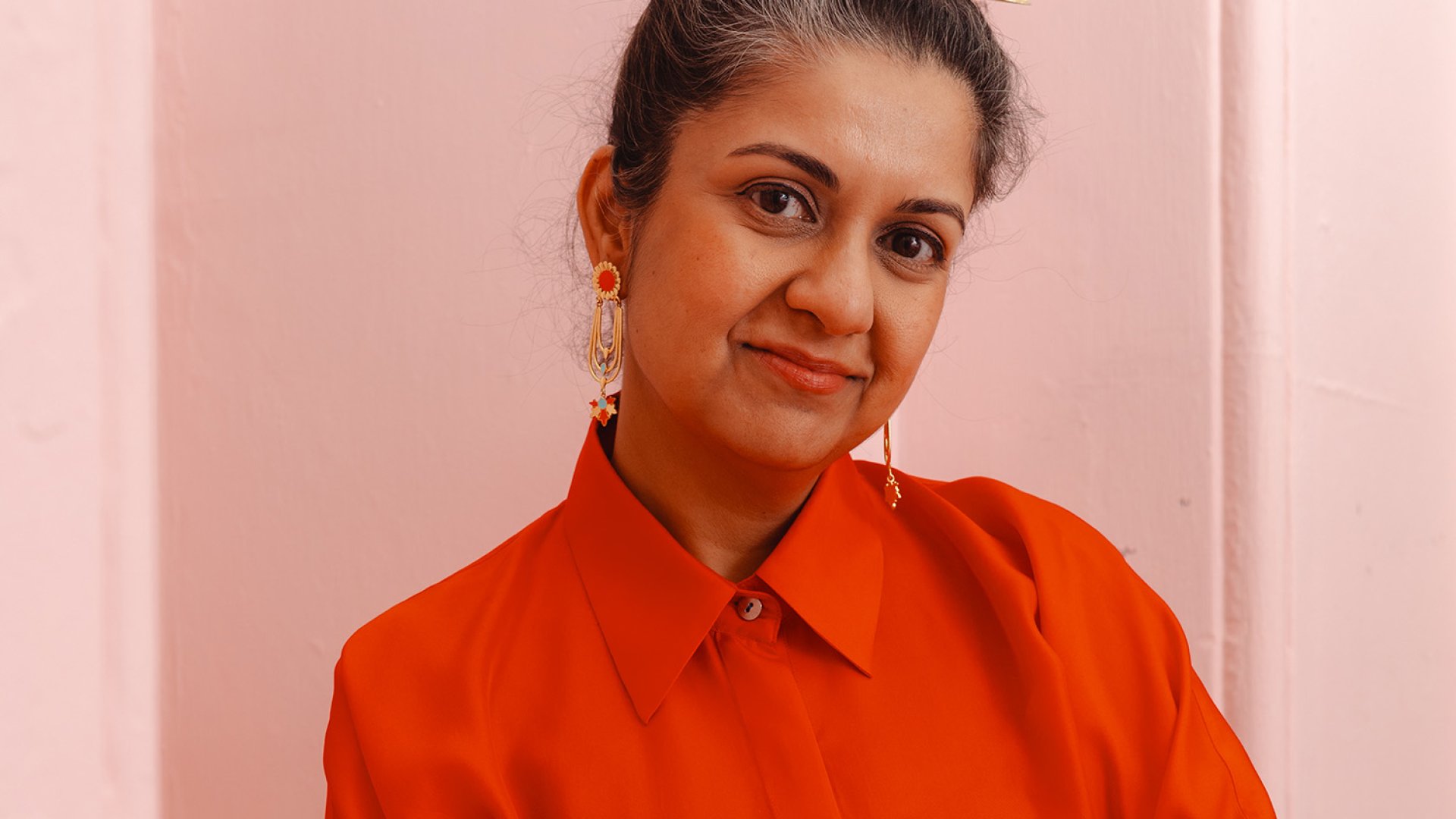
What if a river could talk to you? Or if, hundreds of years from now, people regarded our trainers as sacred objects? For designer Anab Jain, these aren't strange ideas, but ways of seeing the world from a different perspective. Through her studio Superflux, she makes possible futures tangible. At Dutch Design Week (DDW) 2026, she is one of the Beacons. We talk to her about the power of imagination, the intelligence of nature and why designers don't always need to rush towards a solution.
Where might we know you from?
‘Perhaps from Superflux, the design studio I founded with Jon Ardern in 2009. We create possible futures that people can step into, see, feel and experience. Think of a London flat where residents grow food in their living room because of climate change. Or a banquet table at the Venice Architecture Biennale, where there's a place not just for humans, but for other species too.
In the Netherlands, our work was previously shown in Subject to Change, our first solo exhibition at Droog in Amsterdam in 2022. I've also been leading Design Investigations at the University of Applied Arts Vienna for the past ten years. Earlier this year, we published our book Designing Questions.’
What made you say yes to becoming a DDW Beacon?
‘I've always been inspired by DDW's vision and ambition. Being a Beacon gives us an opportunity to shine a light on speculative and critical design, but above all, on the power of imagination.
We live in a time when so many decisions about our future are already being made for us, whether in boardrooms or through the development of new technologies. That's precisely why we need to keep practising our ability to imagine alternatives.
It's also a wonderful opportunity to share our experiences with young designers and spark conversations about the many different things design can be.’
In Nobody Told Me Rivers Dream, you use AI to give a river a voice. How can technology bring us closer to nature?
‘Growing up in Gujarat, India, I learnt that peacocks become loud and restless before the monsoon arrives. In Brazil, for example, howler monkeys signal changes in the environment. All over the world, there are communities that know how to read these signals from nature. Many of us have lost that ability.
With Nobody Told Me Rivers Dream, we reverse the usual role of AI. Sensors along the Thames pick up birdsong, tides and weather conditions. AI combines these signals with local knowledge and translates them into poetic messages for passers-by. Instead of us asking the questions, the river sets the AI in motion. The river prompts the AI, and the AI prompts us.
At the same time, we need to remain critical. Technology can also distance us from nature, particularly when knowledge is collected simply to extract value from it. That's why we keep asking ourselves: who benefits, who has given consent and what does the natural world or community receive in return?
For me, technology is truly valuable when it eventually makes itself redundant. Once you feel how deeply connected you are to a river, you no longer need technology to remind you to protect it.
I've only recently learnt to swim, and I'm still a little afraid of the water. What I'd love most is to swim in the Thames, a river that was once considered sacred, like so many rivers where I grew up. Simply to feel and experience the river for myself.’
In Relics of Abundance, you look at our consumer society from the distant future. Which object tells us the most about our time?
‘The trainer! For me, it's perhaps the ultimate symbol of innovation and consumption.
In Relics of Abundance, we imagine a civilisation in the distant future discovering the remains of our society. They believe we worshipped a god called the Market. Trainers are preserved as sacred objects, living rooms resemble temples and money is seen as a collective illusion.
We even imagined an annual ritual in which a 25-kilo lead shoe is cast, only to be melted down and cast again. A reference to our constant desire for something new.
Perhaps future generations won't even realise that shoes were once meant for walking! We like to think of our society as rational, but from a distance, our endless cycle of buying and throwing things away looks rather strange.
In contrast, we present a traditional stool from the Tukano, an Indigenous community from the Amazon. Its value lies precisely in being passed down through generations. This contrast raises an important question: what do we actually want to leave behind? Mountains of trainers and handbags, or a society that treats objects and materials with greater care?’
What would you like to say to the next generation of designers?
‘Learn to love the questions. The poet Rainer Maria Rilke once wrote to a young poet, encouraging him to try to love the questions themselves. I'd like to offer young designers the same advice.
I grew up in a school system in India where asking questions wasn't encouraged. Saying you didn't know something was seen as a failure. Design has its own version of this: we're used to rushing towards a solution. But try staying with “I don't know” a little longer, even when it feels uncomfortable. Because if the answers we've come up with so far have brought us to where we are today, perhaps we need to get better at asking questions.
Learn from people outside design, but also from places, materials, rivers and mountains. And find people to work alongside, because the questions that really matter today are too big to carry alone.’
Discover more at DDW
Want to hear more from Anab Jain? Join Speculative and futures design: Anab Jain x DDW, a conversation between Anab Jain and architect and educator Janna Bystrykh about the future of design. The event takes place on Saturday 17 October, from 16:00 to 17:30, at the Van Abbemuseum.