Rethinking as Enquiry
Rethink is R1 in the circular economy hierarchy, positioned immediately after Refuse and above reuse, repair and recycle (Potting et al., 2017). Its elevated position notwithstanding, it remains the least procedurally articulated of the R strategies, prescribed as a priority without an account of what rethinking would involve.
This workshop approaches that underdefinition as a site of enquiry rather than a gap to be closed, examining it along three axes where circular discourse may be understood to foreclose the transformation it proposes. The temporal axis, where circular design tends to inherit a linear conception of time that marginalises other temporalities (Mignolo and Walsh, 2018). The epistemic axis, where circularity has been argued to take Western technoscientific knowledge as the universal ground of transition (Corvellec et al., 2022). The agential axis, where an emphasis on material flows can render less visible the more-than-human agencies through which circular processes are constituted (Latour, 2014).
These axes draw on anticipation studies, Deleuzian and decolonial philosophy, and speculative design (Deleuze, 1994; Dunne and Raby, 2013; Miller, 2018).
The Matrix Answers Back
Participants arrive with a project of their own, circular or otherwise, and interrogate it through nine prompts answered on a phone, asking which temporalities the project works with and which agents it allows to act.
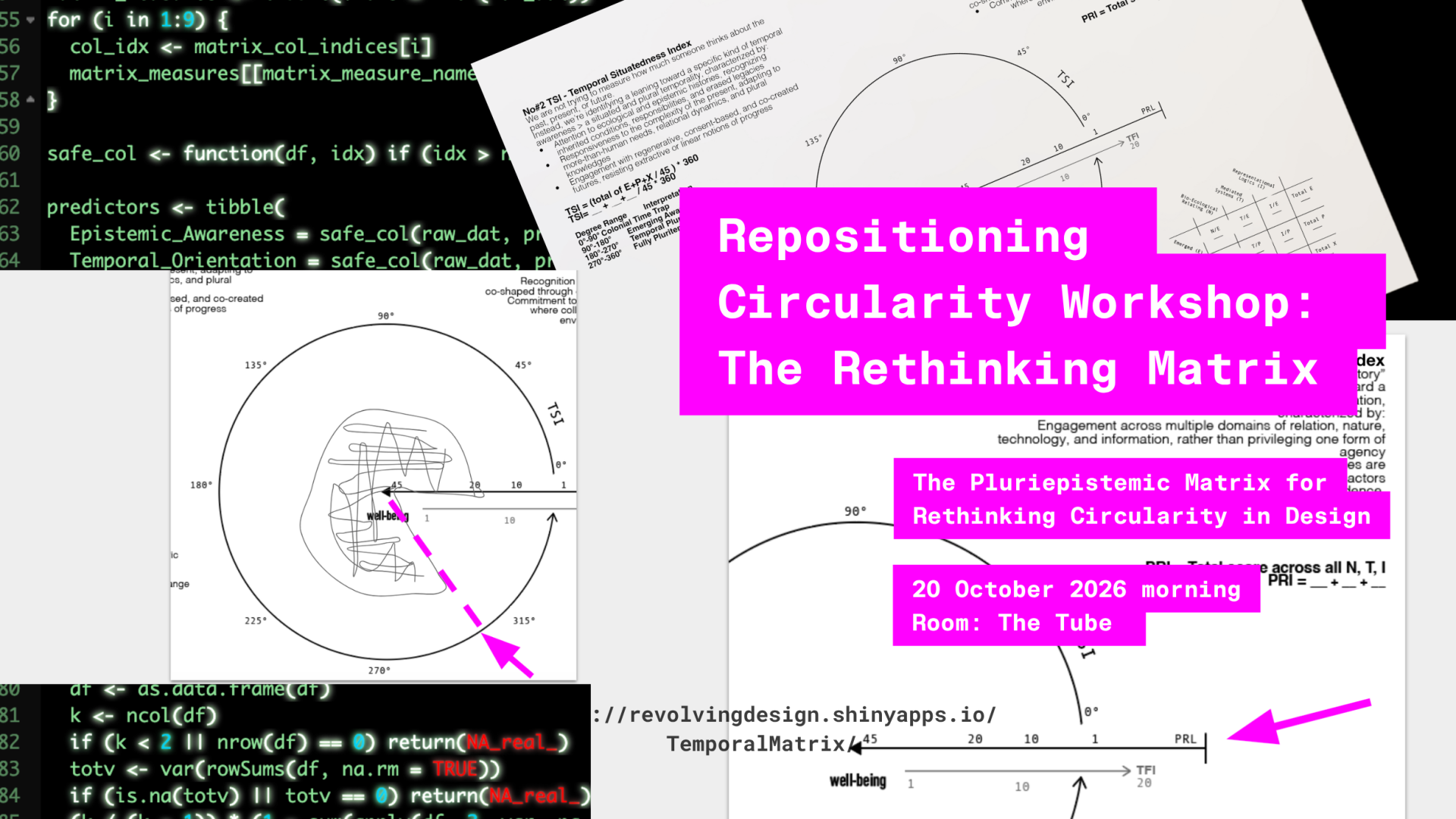
Answers are drawn by hand onto a diagram of multiagential and multitemporal circular form, where the centre is wellbeing rather than technocentric efficiency.
The presenters, a designer and a political scientist, have attempted to turn quantitative data into speculative reading. While participants assess their own answers, the facilitators draw the room's collective diagram and open it for discussion. What appears is a speculative shape for rethinking what circularity for regeneration and wellbeing might represent, rather than a verdict.